
Many faiths. One Halton.
Since 2001 the Interfaith Council of Halton has brought eight faith traditions together — to learn from one another, to stand together when it matters, and to build a community where everyone belongs.

Join us
Everyone is welcome at the table
Whether you represent a faith community, work in education or policing, or simply want to understand your neighbours better — we would be glad to hear from you.
- We meet at
- Shaarei Beth-El Synagogue
186 Morrison Road, Oakville, ON L4J 8B4
- Follow us
- Our Facebook group
Our mission
To build an inclusive and welcoming community for all citizens of Halton through education.
Who we are
Compassion brought us together
The Interfaith Council of Halton was formed in 2001, out of compassion — at a time when hatred, discrimination, supremacism and phobias in many forms were hurting communities here and around the world. Neighbours of different faiths chose to meet rather than retreat: to stand in solidarity with one another, and to say no to injustice, racism and prejudice of all kinds.
The commitment at the heart of it was a simple one: to learn from, respect and honour each other. It still is.
Along our journey of discovery we have found that despite the many different practices and rituals of our faiths, the essence of our core values is the same.
The Golden Rule — treat others as you would wish to be treated — is shared by every one of our traditions, and remains the clearest expression of that common ground.

Our members
Eight faith traditions, one table
The Council brings together representatives of eight major faith communities that meet across the Halton Region. Everyone comes as themselves, and no one is asked to be anything else. Open any tradition below for a short introduction and its scriptures — and select any principle within it to read what that principle means.
Bahá’í Faith
Founded by Bahá’u’lláh in nineteenth-century Persia. The Bahá’í teachings hold that there is one God, that the great religions are successive chapters of a single unfolding faith, and that humanity is one family now coming of age.
Core principles
Oneness of God
There is one God, unknowable in essence, who has revealed His will through a succession of Messengers across history.
Oneness of religion
The great faiths come from the same source and teach the same essential truths, each suited to the age it was revealed in. Bahá’ís call this progressive revelation.
Oneness of humanity
Humanity is a single people. Distinctions of race, nation and class are seen as human inventions to be set aside, not divine orders to be kept.
Independent search for truth
Each person is responsible for investigating truth for themselves, rather than accepting belief by inheritance or imitation.
Equality of women and men
Held as a spiritual principle, not only a social one. Bahá’u’lláh likened humanity to a bird whose two wings must be equally strong for it to fly.
Universal education
Education is a duty owed to every child. Where a family can educate only one child, the daughter is given precedence, since she will be the first educator of the next generation.
Harmony of science and religion
Religion without science becomes superstition; science without religion becomes materialism. Both are needed, and true findings of each cannot contradict the other.
The earth is but one country, and mankind its citizens.Bahá’u’lláh, Gleanings from the Writings of Bahá’u’lláh
Buddhism
Rooted in the awakening of Siddhartha Gautama, the Buddha. The Four Noble Truths diagnose the human condition; the Noble Eightfold Path is the treatment. Compassion and the refusal to cause harm run through the whole of it.
The Four Noble Truths
Dukkha — there is suffering
Life as ordinarily lived contains dissatisfaction, loss and pain. This is stated as an observation, not a complaint.
Samudaya — suffering has a cause
Suffering arises from craving and attachment — grasping at what is pleasant, pushing away what is not.
Nirodha — suffering can end
Because suffering has a cause, it can cease. The end of craving is the end of suffering: nirvana.
Magga — there is a path
The Noble Eightfold Path is the way to that cessation — a practical training rather than a belief to accept.
The Noble Eightfold Path
Right view
Seeing things as they actually are, including the Four Noble Truths.
Right intention
Renouncing ill-will and cruelty; the resolve towards goodwill and harmlessness.
Right speech
Abstaining from lying, divisive talk, harsh words and idle chatter.
Right action
Abstaining from killing, taking what is not given, and sexual misconduct.
Right livelihood
Earning a living in a way that does not cause harm to others.
Right effort
Cultivating wholesome states of mind and letting go of unwholesome ones.
Right mindfulness
Steady, clear awareness of body, feelings, mind and phenomena.
Right concentration
The disciplined stillness of mind developed through meditation.
The Three Jewels
The Buddha
The teacher who awakened, and the possibility of awakening he demonstrates.
The Dharma
His teaching, and the truth it points to.
The Sangha
The community of practitioners. Taking refuge in these three is what marks a person as Buddhist.
The Five Precepts
Not to kill
To refrain from taking life — the foundation of non-harming.
Not to steal
To refrain from taking what has not been given.
Not to misuse the senses
To refrain from sexual misconduct and from causing harm through desire.
Not to speak falsely
To refrain from lying and deceitful speech.
Not to cloud the mind
To refrain from intoxicants that undermine clarity and self-control.
Hatred is never appeased by hatred in this world; by non-hatred alone is hatred appeased. This is an eternal law.Dhammapada, verse 5
Christianity — Protestant & Catholic
Faith in one God, revealed as Father, Son and Holy Spirit, and in Jesus Christ as Saviour. The scriptures are the Old and New Testaments. Asked which commandment was the greatest, Jesus gave two, and made the second inseparable from the first.
Core beliefs
One God in three persons
The doctrine of the Trinity: one God, eternally Father, Son and Holy Spirit. Affirmed in the Nicene Creed of 325 AD, shared across Catholic, Orthodox and Protestant churches.
The incarnation
That God became human in Jesus of Nazareth — fully divine and fully human.
Death and resurrection
Christians hold that Jesus was crucified, died, and rose on the third day; the resurrection is the centre of Christian hope.
Scripture
The Bible: the Old Testament shared with Judaism, and the New Testament of the Gospels, letters and Revelation.
Baptism and communion
Two sacraments observed across nearly all churches — baptism marking entry into the faith, communion recalling the last supper.
Grace and forgiveness
That God’s love is given freely rather than earned, and that those who receive it are called to forgive others.
Service to the poor
The care of the hungry, the sick, the imprisoned and the stranger, which Jesus identified with care for himself (Matthew 25).
Love the Lord your God with all your heart … and love your neighbour as yourself.Mark 12:30–31
So in everything, do to others what you would have them do to you.Matthew 7:12
Hinduism
Among the oldest living traditions, drawing on the Vedas, the Upanishads and the Bhagavad Gita. One divine reality, Brahman, is worshipped in many forms. Life is shaped by right conduct and by the moral weight of action.
Core concepts
Brahman
The one ultimate reality underlying all things, worshipped through many names and forms. The divine within each person is called atman.
Dharma
Right conduct: the duty appropriate to a person’s stage of life, role and circumstances. Living in accordance with dharma sustains both the individual and the social order.
Karma
Every action carries consequence. Karma is not fate but causation — what is done returns, in this life or another.
Samsara
The cycle of birth, death and rebirth through which the soul passes.
Moksha
Liberation from that cycle, and union with the ultimate reality. The final goal of human life.
Ahimsa
Non-violence in thought, word and deed — held as the highest duty, and the root of the tradition’s emphasis on compassion towards all living beings.
The scriptures
The Vedas, the oldest layer; the Upanishads, their philosophical culmination; and the Bhagavad Gita, in which Krishna sets out duty, devotion and detachment.
One is a relative, the other a stranger, say the small-minded. To those of noble conduct, the whole world is one family.Mahopanishad 6:71 — Vasudhaiva Kutumbakam
Islam
Belief in one God, Allah, and in Muhammad (peace be upon him) as His final messenger. When the angel Jibril came to question the Prophet before his companions, the answers he gave set out both faith and practice — six articles of belief, and five pillars of action.
The six articles of faith — Hadith Jibril, Sahih Muslim 8
God
Belief in one God, without partner, equal or offspring — the Creator and Sustainer of all that exists, known through His names and attributes.
His angels
Beings created from light who carry out God’s command without disobedience. Among them Jibril, who brought revelation to the prophets.
His revealed books
The scriptures God sent to humanity — including the Tawrat given to Moses, the Zabur to David, the Injil to Jesus, and the Qur’an, the final revelation, preserved unchanged.
His messengers
The prophets raised up among every people — from Adam through Noah, Abraham, Moses and Jesus, to Muhammad (peace be upon him), the last of them. Muslims are required to honour them all.
The Day of Judgement
The resurrection and the reckoning, when every person will answer for what they did, and nothing done in secret will remain hidden.
Divine decree
That God’s knowledge and will encompass all things — in the words of the hadith, “divine destiny, both its good and its evil” — held together with each person’s responsibility for their own choices.
The five pillars — Sahih al-Bukhari 8, Sahih Muslim 16
Shahada — declaration of faith
To bear witness that there is no god but God, and that Muhammad is the messenger of God. Said sincerely, it makes a person Muslim; it is the foundation the other four rest on.
Salah — prayer
Five prayers at appointed times each day, from before dawn until night, facing the Ka’bah in Mecca. Prayer punctuates the whole day rather than being set aside for one part of it.
Zakat — charity
An annual obligation on accumulated wealth, ordinarily one-fortieth — 2.5 per cent — given to the poor and the other categories named in the Qur’an. It is understood as the recipient’s right, not the giver’s generosity.
Sawm — fasting in Ramadan
Abstaining from food, drink and intimacy from dawn to sunset through the month of Ramadan. Its stated purpose is taqwa — God-consciousness — and it is widely experienced as an education in what hunger feels like.
Hajj — pilgrimage
The pilgrimage to Mecca, obligatory once in a lifetime on every Muslim with the health and the means to make it. Pilgrims dress alike, so that rank and wealth are indistinguishable.
Whoever kills a soul … it is as if he had slain all of mankind. And whoever saves one — it is as if he had saved all of mankind.Qur’an 5:32
He is not a believer whose stomach is filled while his neighbour goes hungry.Hadith — Al-Adab al-Mufrad 112, narrated by Ibn ‘Abbas
If the Hour comes upon one of you while he has a seedling in his hand, let him plant it.Hadith — Musnad Ahmad
Judaism
The covenant between God and the Jewish people, carried in the Torah and lived through the commandments. The Shema declares that God is one. The duty to repair what is broken in the world shapes the obligation to justice and to care for the stranger.
Core beliefs and practices
One God
The uncompromising oneness of God, without form or division — the conviction Judaism carried into the world.
Torah
The five books of Moses, and more broadly the whole body of Jewish teaching. Study of Torah is itself an act of worship.
The covenant
The binding relationship between God and the Jewish people, beginning with Abraham and renewed at Sinai.
The Shema
“Hear, O Israel: the Lord our God, the Lord is one” (Deuteronomy 6:4) — recited morning and evening, and the words a Jew hopes to die with.
The mitzvot
The commandments — traditionally counted as 613 — through which faith is expressed in daily conduct rather than belief alone.
Shabbat
The seventh day, kept as rest from creation and work. A weekly refusal to be defined by productivity.
Tikkun olam
The repair of the world: the obligation to leave the world better ordered and more just than it was found.
Love your neighbour as yourself.Leviticus 19:18
What is hateful to you, do not do to your fellow. That is the whole Torah; the rest is commentary — go and learn it.Hillel the Elder, Talmud, Shabbat 31a
Sikhism
Founded by Guru Nanak (1469–1539) and shaped by ten Gurus, with the Guru Granth Sahib as the living Guru today. There is one God, and every person stands equal before God — a claim Sikhism has always insisted on putting into practice, not only into words.
Core beliefs
Ik Onkar
“There is one God” — the opening words of the Guru Granth Sahib and the foundation of Sikh belief. One creator, present in all creation.
The ten Gurus
From Guru Nanak to Guru Gobind Singh, who declared the scripture itself the eternal Guru thereafter.
Guru Granth Sahib
The Sikh scripture, treated as a living Guru. It includes hymns by Hindu and Muslim saints alongside those of the Sikh Gurus.
Equality of all people
Sikhism rejects caste, and affirms the equality of women and men, from its foundation.
The three pillars
Naam Japo
Remember God — keep the divine name present in the mind through meditation and recitation.
Kirat Karo
Earn honestly — make an honest living by one’s own effort, without exploitation.
Vand Chhako
Share with others — give from what you earn, so that no one around you goes without.
In practice
Seva
Selfless service given without expectation of reward or recognition.
Langar
The free kitchen attached to every gurdwara, where anyone of any background sits on the same floor and eats the same meal. Instituted by Guru Nanak as equality made edible.
Truth is the highest virtue, but higher still is truthful living.Guru Nanak, Sri Guru Granth Sahib, Ang 62
Zoroastrianism
One of the world’s oldest revealed religions, taught by the prophet Zarathushtra. Ahura Mazda, the Wise Lord, is worshipped as the source of all good. Life is understood as a choice between truth and falsehood — a choice every person makes freely, and is answerable for.
Core beliefs
Ahura Mazda
The Wise Lord — one God, creator of all that is good, worshipped without image.
Asha
Truth, order and righteousness: the pattern the universe is meant to follow, and which human beings are asked to uphold.
Druj
Falsehood and disorder — the opposing principle. Life is the arena in which each person chooses between the two.
Free choice
Zoroastrianism places responsibility squarely on the individual. No one is compelled; everyone chooses, and everyone answers for the choice.
Care for creation
Fire, water, earth and air are honoured as pure creations to be kept from pollution — an ethic of environmental care built into the religion’s ritual life.
The threefold path
Humata — good thoughts
What is thought comes first: the intention behind an act determines its worth.
Hukhta — good words
Speech that is truthful and does not harm. Zoroastrian ethics treat the broken promise as a serious wrong.
Huvarshta — good deeds
Right action, following from right thought and right speech. Together these three words summarise the whole of the faith.
Happiness be the lot of him who works for the happiness of others.The Gathas, Ushtavaiti Gatha, Yasna 43:1
These are short introductions, not full accounts — each tradition is far richer than a page allows. If you belong to one of these communities and would suggest a correction or a better-chosen passage, we would welcome it: please get in touch.
Our objectives
The four things we set out to do
- Education
- Community leadership development
- Advocacy
- Information to media and public
What we do
Four strands of work
Running year-round across Oakville, Burlington, Milton and Halton Hills.

Interfaith dialogue
Regular gatherings where members share the practices of their own tradition — fasting, festivals, prayer — and answer each other’s questions honestly.
Explore our dialogue →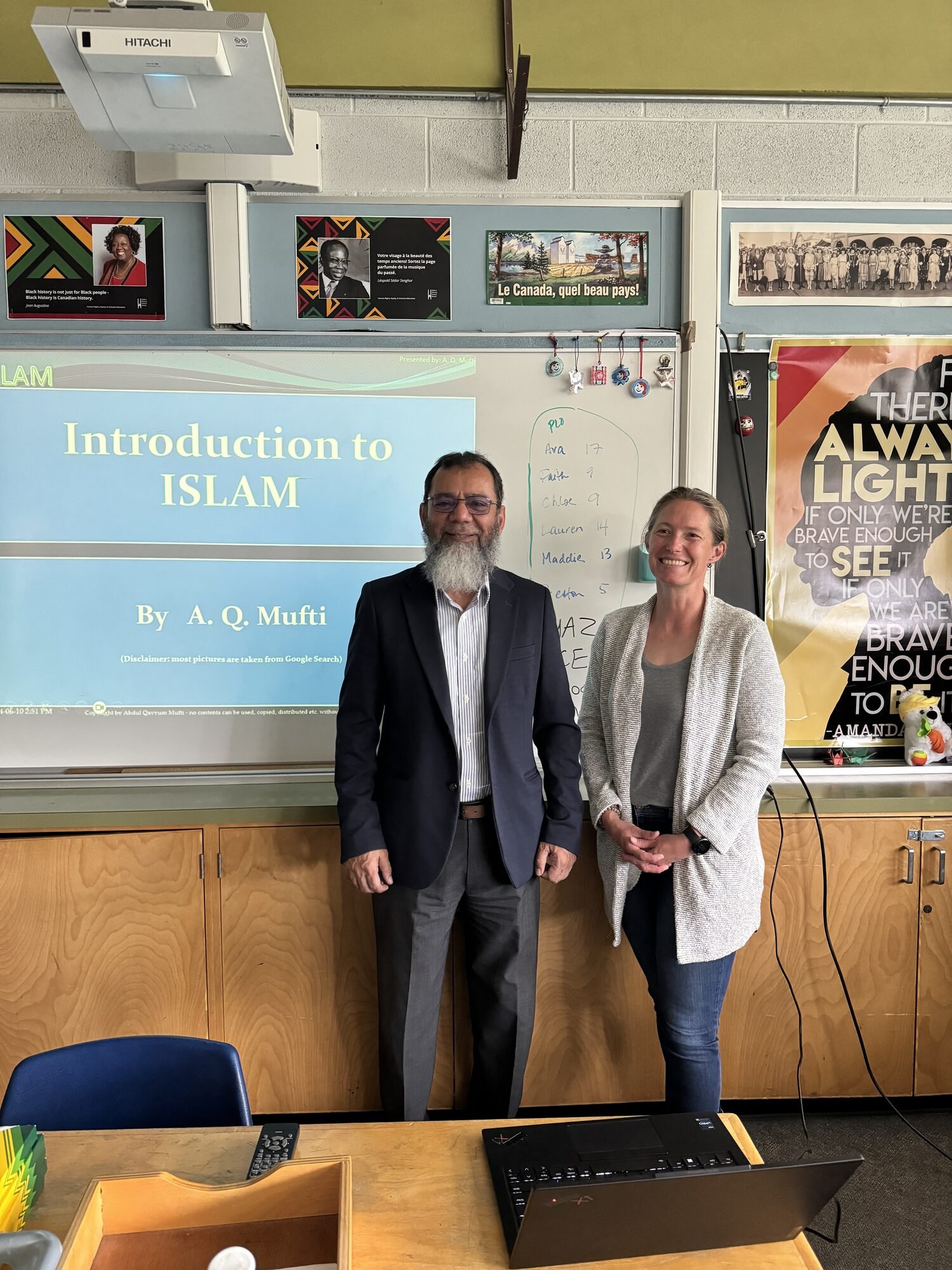
Interfaith Youth Festival
Students move between booths staffed by each faith community, carrying a passport to record what they learn. The Council has run it since its very first year.
About the festival →
The Golden Rule
Treat others as you would wish to be treated. Nearly every tradition teaches it in its own words — and it is the principle the Council keeps returning to.
Read the Golden Rule →
Standing together
Public prayers for peace, vigils after tragedy, refugee sponsorship, and a voice for the faith communities of Halton when one of them is under pressure.
See past events →Recognition
The first Gold Medal for Excellence
“In recognition of their outstanding contribution to the promotion of race relations.”
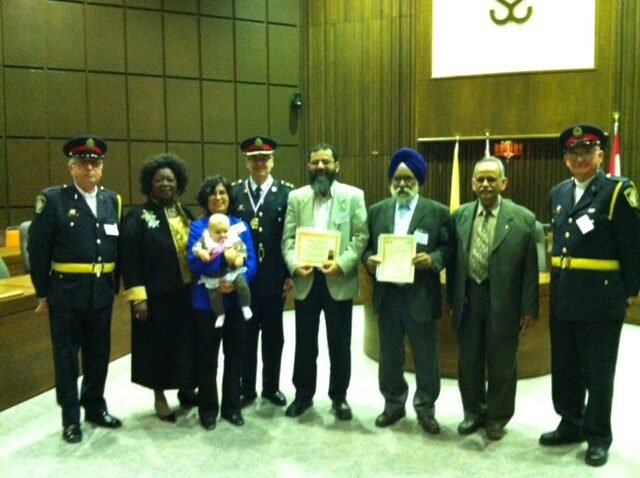
In March 2011 the Human Rights and Race Relations Centre in Toronto awarded its first ever Gold Medal for Excellence to the Halton Regional Police Service Multi-Faith Support Team — a team of eight members drawn from the Christian, Islamic, Sikh, Bahá’í, Hindu, Jewish and Catholic faiths, available to officers and staff twenty-four hours a day.
The Interfaith Council of Halton is represented on that team, and has itself been honoured by the same Centre.
Come and see for yourself
Meetings, events and public gatherings are open to everyone in Halton.